Navigating High Stakes Guest Interactions in Orlando Hospitality
This learning experience addresses inconsistent service quality in high-pressure hospitality environments by training frontline staff to make effective, empathetic decisions during real-time guest interactions. Utilizing the D.E.A.R. Method, learners focus on realistic practice maintaining a calm, empathetic and professional tone with guests
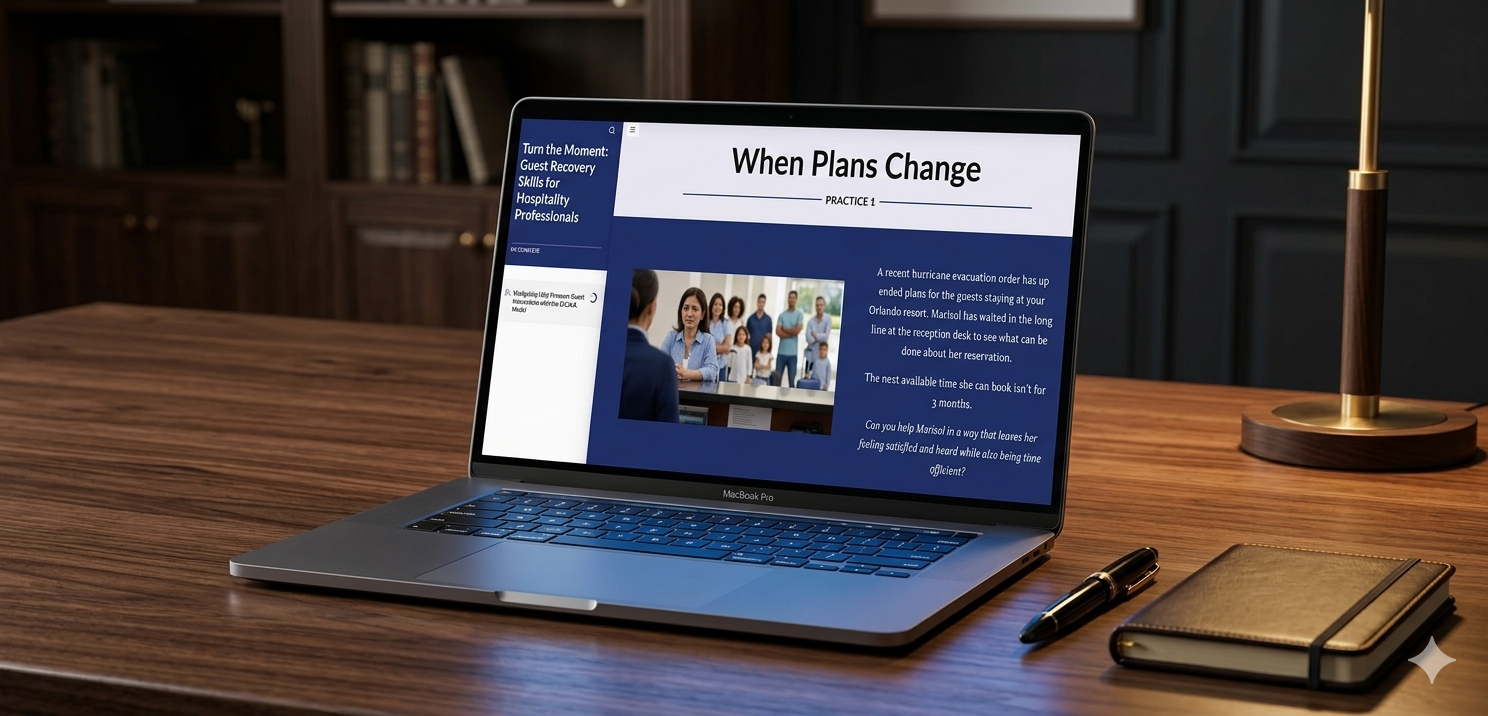
Format: Micro-learning simulation (10–15 min total)
Audience: Frontline hospitality staff (hotels, theme parks, restaurants)
Core Methodology:
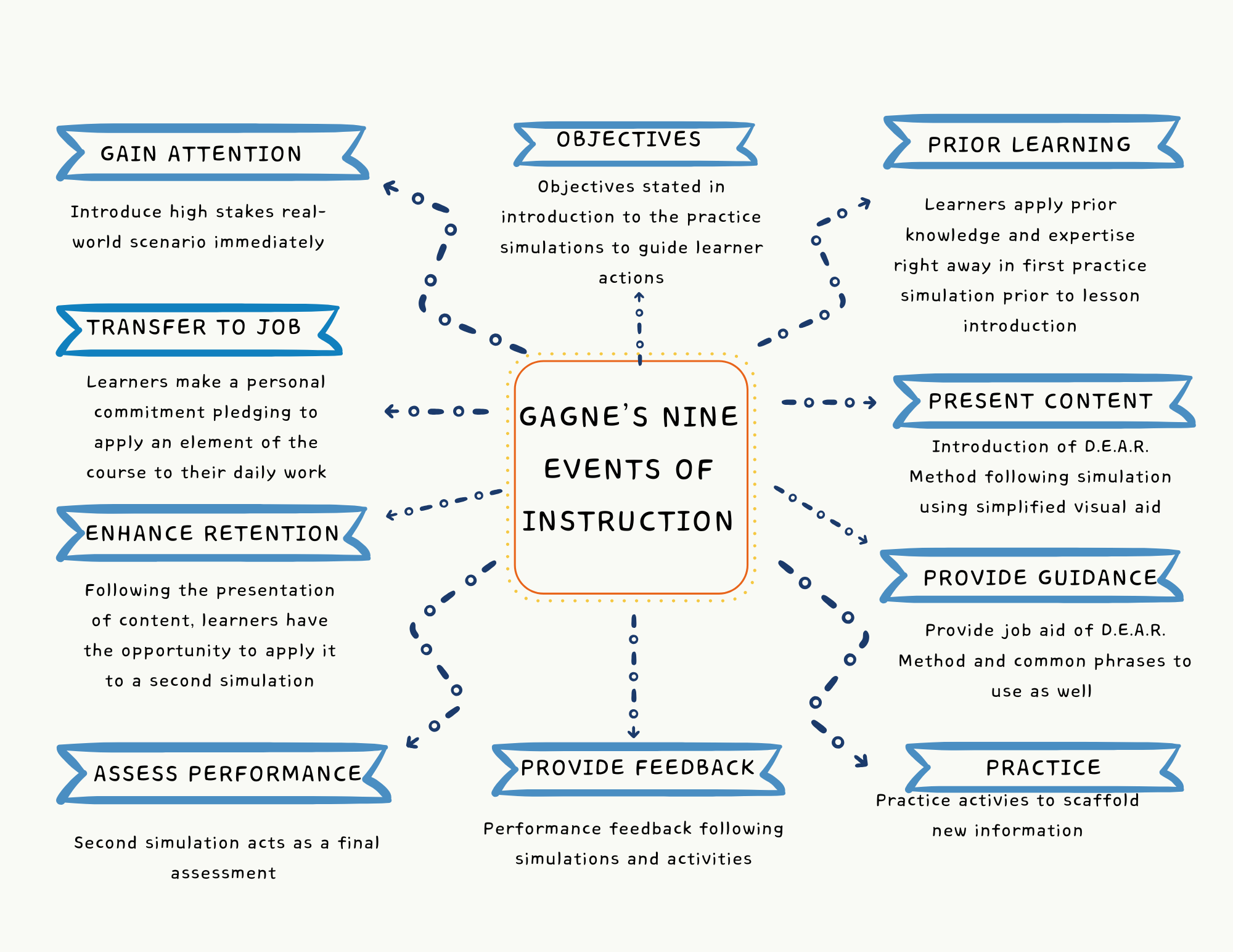
Gagne’s Nine Events
Scenario-Based Learning through AI-driven conversation simulation
Branching decision paths and consequence-based feedback
Action-Mapping
Andragogy
Tools Used:
Articulate Rise
Articulate Storyline
Devlin.ai
Canva
Freepik
Claude AI
Purpose of eLearning
This course places learners specifically in the environment they work in — a peak shift near Universal Orlando Resort, an understaffed concierge desk, a couple whose reservation has disappeared at check-in — encouraging learners to use their existing experience immediately.
The result is a course focused on the key principles of andragogy: relevance and autonomy
A hospitality worker in Orlando doesn't just see a frustrated guest in this course — they see their frustrated guest.
Guest Interaction Simulation
This course does not tell learners what guest recovery means — it lets them discover it.
The cold open simulation places learners in a high-pressure guest interaction before any framework has been introduced, which means every learner constructs their own initial theory of what works.
Link button to stand alone chatbot via storyline (not whole Rise project)
Change picture to a screenshot of chatbot
Performance Dashboard
Change image to screenshot of Performance Dashboard
Explain the different elements of the performance dashboard and why they are used
The dashboard makes visible what is normally invisible in a real guest interaction — the cumulative effect of small communication choices — and gives learners immediate feedback they can act on before their next shift.
The branching paths lead to genuinely different outcomes based on the choices made by the learner as they balance efficiency, guest satisfaction, and empathy.
Learners who respond too quickly see efficiency, but low satisfaction.
Learners who respond warmly, but slowly, see the opposite.
Reflection
The reflection follows the initial simulation, but prior to the introduction of the D.E.A.R. method content, in order to promote reflective observation as outlined by David Kolb and Experiential Learning
In a live deployment, this reflection prompt would connect to a facilitator dashboard, enabling managers to identify common struggle points across their team before a follow-up coaching conversation.
D.E.A.R. Method & Activities
Review the method
Cognitivism using a mnemonic device
Activities (matching and video) enable learners
Replace image with a DEAR Job Aid
Second Chatbot Purpose
Explain purpose of second chatbot and why it follows lesson on D.E.A.R.
Replace image with a screenshot of second Chatbot
Personal Commitment
Explain purpose of personal commitment
Focus on behavioral change, not knowledge recall
the personal commitment closer asks them to identify their own growth edges rather than telling them what to improve. The reflection prompts assume competence and invite self-direction rather than prescribing a correct answer.
Humanism focus on personal growth
Replace image with a screenshot of personal commitment section
Cognitive Load Theory
Cognitive Load Theory → Minimal Fluff, High Relevance
Every instructional decision in this course was evaluated against one question: does this reduce the learner's ability to focus on what actually matters? The course contains no lengthy prerequisite readings, no exhaustive policy reviews, and no content that exists purely to feel thorough. The D.E.A.R. framework is introduced as four steps, not fourteen competencies. The performance dashboard after the first simulation gives learners three data points, not a detailed rubric. Visual design follows the same principle — a disciplined color palette, generous white space, and consistent typography reduce the cognitive work of processing the interface so learners can direct their full attention to the scenario in front of them. When learners aren't overwhelmed by the course itself, they have more mental capacity available for the difficult judgment calls the course is actually asking them to practice.
Commodo cursus magna, vel scelerisque nisl consectetur et. Donec id elit non mi porta gravida at eget metus.